Capacitively Coupled Charge Qubits
This project started in the Fall of 2014, focusing on the operation of two or more charge qubits which are capacitively coupled.
General Formulation

For a single charge qubit, the Hamiltonian is
- [math]\displaystyle{ H_i = \left( \begin{matrix} \epsilon_i/2 & \Delta_i \\ \Delta_i & -\epsilon_i/2 \end{matrix}\right) }[/math]
We will refer to [math]\displaystyle{ \epsilon_i }[/math] and [math]\displaystyle{ \Delta_i }[/math] as the detuning and tunnel coupling of qubit [math]\displaystyle{ i }[/math], respectively.
We can further write down the full Hamiltonian explicitly:
- [math]\displaystyle{ H = \left( \begin{matrix} \frac{1}{2}(\epsilon_1+\epsilon_2) + g & \Delta_2 & \Delta_1 & 0 \\ \Delta_2 & \frac{1}{2}(\epsilon_1-\epsilon_2) - g & 0 & \Delta_1 \\ \Delta_1 & 0 & \frac{1}{2}(-\epsilon_1+\epsilon_2) - g & \Delta_2 \\ 0 & \Delta_1 & \Delta_2 & \frac{1}{2}(-\epsilon_1-\epsilon_2) + g \end{matrix}\right) }[/math]
where [math]\displaystyle{ g }[/math] is the capacitive coupling between the qubits.
Sweet Spots
A major issue with charge qubits is that they are very susceptible to charge noise, which occurs when charge fluctuations outside the system induce undesired shifts in the parameters of the Hamiltonian. The goal of a sweet spot is to find a point in the parameter space where the energy levels are as invariant to the shifts as possible.
First Order Detuning Noise
The most dominant noise source is due to the shifts in the detuning. It is believed that the only point at which the first order dependence on the detunings disappears is at [math]\displaystyle{ \epsilon_1 = \epsilon_2 = 0 }[/math]. This has been confirmed analytically in the limit of small [math]\displaystyle{ g }[/math], and no exceptions have been observed numerically.
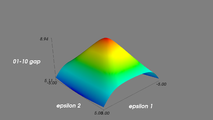
Gap between 01 and 10 states
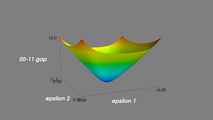
Gap between 00 and 11 states
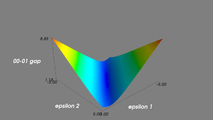
Gap between 00 and 01 states
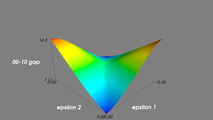
Gap between 00 and 10 states


Second Order Detuning Noise
For [math]\displaystyle{ \epsilon_2 = 0 }[/math], we have the following energy levels:
[math]\displaystyle{ \lambda_1 = -\sqrt{\Delta_1^2+\Delta_2^2+\frac{\epsilon_1^2}{4}+g^2+\sqrt{4\Delta_1^2\Delta_2^2+\epsilon_1^2(\Delta_2^2+g^2)}} }[/math]
[math]\displaystyle{ \lambda_2 = -\sqrt{\Delta_1^2+\Delta_2^2+\frac{\epsilon_1^2}{4}+g^2-\sqrt{4\Delta_1^2\Delta_2^2+\epsilon_1^2(\Delta_2^2+g^2)}} }[/math]
[math]\displaystyle{ \lambda_3 = \sqrt{\Delta_1^2+\Delta_2^2+\frac{\epsilon_1^2}{4}+g^2-\sqrt{4\Delta_1^2\Delta_2^2+\epsilon_1^2(\Delta_2^2+g^2)}} }[/math]
[math]\displaystyle{ \lambda_4 = \sqrt{\Delta_1^2+\Delta_2^2+\frac{\epsilon_1^2}{4}+g^2+\sqrt{4\Delta_1^2\Delta_2^2+\epsilon_1^2(\Delta_2^2+g^2)}} }[/math]
which to second order in [math]\displaystyle{ \epsilon_1 }[/math] are:

[math]\displaystyle{ \lambda_1 \approx \lambda_1^0 + \frac{\Delta_2(\Delta_1+\Delta_2)+g^2}{8\Delta_1\Delta_2\lambda_1^0}\epsilon_1^2 }[/math]
[math]\displaystyle{ \lambda_2 \approx \lambda_2^0 + \frac{\Delta_2(\Delta_1-\Delta_2)-g^2}{8\Delta_1\Delta_2\lambda_2^0}\epsilon_1^2 }[/math]
[math]\displaystyle{ \lambda_3 \approx \lambda_3^0 + \frac{\Delta_2(\Delta_1-\Delta_2)-g^2}{8\Delta_1\Delta_2\lambda_3^0}\epsilon_1^2 }[/math]
[math]\displaystyle{ \lambda_4 \approx \lambda_4^0 + \frac{\Delta_2(\Delta_1+\Delta_2)+g^2}{8\Delta_1\Delta_2\lambda_4^0}\epsilon_1^2 }[/math]
The second order terms cannot be tuned such that all gaps are invariant to second order noise. However, [math]\displaystyle{ g }[/math] can be tuned such that some of the transitions become invariant to some of the second order detuning shifts. To make the transition between [math]\displaystyle{ |01\rangle }[/math] and [math]\displaystyle{ |10\rangle }[/math] flat with respect to second order fluctuations in [math]\displaystyle{ \epsilon_1 }[/math], we can set
[math]\displaystyle{ g^2 = \Delta_2(\Delta_1-\Delta_2) }[/math]
Unfortunately, none of the other transitions can be made to be invariant to second order fluctuations in [math]\displaystyle{ \epsilon_1 }[/math]. Also, If we wish to make this transition invariant to all second order detuning fluctuations, we must set [math]\displaystyle{ \Delta_1 = \Delta_2 }[/math], making [math]\displaystyle{ g = 0 }[/math].
Tunnel Coupling and Capacitive Coupling Noise

Assuming that we sit at the sweet spot [math]\displaystyle{ \epsilon_1 = \epsilon_2 = 0 }[/math], the energies are relatively simple, so we can easily see the effect of noise on the other parameters.
| State | Energy | Effect of [math]\displaystyle{ \delta\Delta_1 }[/math] | Effect of [math]\displaystyle{ \delta g }[/math] |
|---|---|---|---|
| [math]\displaystyle{ |00\rangle }[/math] | [math]\displaystyle{ -\sqrt{(\Delta_1+\Delta_2)^2 + g^2} }[/math] | [math]\displaystyle{ -\frac{(\Delta_1+\Delta_2)}{\sqrt{(\Delta_1+\Delta_2)^2 + g^2}}\delta\Delta_1 }[/math] | [math]\displaystyle{ -\frac{g}{\sqrt{(\Delta_1+\Delta_2)^2 + g^2}}\delta g }[/math] |
| [math]\displaystyle{ |01\rangle }[/math] | [math]\displaystyle{ -\sqrt{(\Delta_1-\Delta_2)^2 + g^2} }[/math] | [math]\displaystyle{ -\frac{(\Delta_1-\Delta_2)}{\sqrt{(\Delta_1-\Delta_2)^2 + g^2}}\delta\Delta_1 }[/math] | [math]\displaystyle{ -\frac{g}{\sqrt{(\Delta_1-\Delta_2)^2 + g^2}}\delta g }[/math] |
| [math]\displaystyle{ |10\rangle }[/math] | [math]\displaystyle{ \sqrt{(\Delta_1-\Delta_2)^2 + g^2} }[/math] | [math]\displaystyle{ \frac{(\Delta_1-\Delta_2)}{\sqrt{(\Delta_1-\Delta_2)^2 + g^2}}\delta\Delta_1 }[/math] | [math]\displaystyle{ \frac{g}{\sqrt{(\Delta_1-\Delta_2)^2 + g^2}}\delta g }[/math] |
| [math]\displaystyle{ |11\rangle }[/math] | [math]\displaystyle{ \sqrt{(\Delta_1+\Delta_2)^2 + g^2} }[/math] | [math]\displaystyle{ \frac{(\Delta_1+\Delta_2)}{\sqrt{(\Delta_1+\Delta_2)^2 + g^2}}\delta\Delta_1 }[/math] | [math]\displaystyle{ \frac{g}{\sqrt{(\Delta_1+\Delta_2)^2 + g^2}}\delta g }[/math] |
Note that if we want any of the transitions to be invariant to first-order fluctuations in tunnel coupling, we would need to set either [math]\displaystyle{ \Delta_1 }[/math] or [math]\displaystyle{ \Delta_2 }[/math] to zero or set [math]\displaystyle{ \Delta_1 = \Delta_2 }[/math]. The first change would make the energy levels degenerate, which must be avoided. If we set the tunnel couplings to be equal, it would be impossible to make any of the transitions invariant to second order effects in the detuning.
There is nothing we can do short of making the energy levels degenerate to make the transitions invariant with respect to first-order fluctuations in capacitive coupling. We could, however, make the coupling itself as stable as possible through manipulating the geometry of the system.
Rotations
Shifting to the Rotating Frame
After bringing the system adiabatically to the sweet spot [math]\displaystyle{ \epsilon_1=\epsilon_2=0 }[/math], we can apply an AC pulse to some of our parameters to induce a rotation within the system.
| AC Pulse | Resulting Matrix (Lab Basis) | Resulting Matrix (Energy Basis) |
|---|---|---|
| [math]\displaystyle{ \epsilon_1 }[/math] | [math]\displaystyle{ \frac{1}{2}\left( \begin{matrix} B & 0 & 0 & 0 \\ 0 & B & 0 & 0 \\ 0 & 0 & -B & 0 \\ 0 & 0 & 0 & -B \end{matrix}\right)\cos{(\omega_{AC}t)} }[/math] | [math]\displaystyle{ \frac{1}{2}\left( \begin{matrix} 0 & A_1\times\text{Sign}(\Delta_1-\Delta_2) & -A_2 & 0 \\ A_1\times\text{Sign}(\Delta_1-\Delta_2) & 0 & 0 & -A_2\times\text{Sign}(\Delta_1-\Delta_2) \\ -A_2 & 0 & 0 & -A_1 \\ 0 & -A_2\times\text{Sign}(\Delta_1-\Delta_2) & -A_1 & 0 \end{matrix}\right)\cos{(\omega_{AC}t)} }[/math] |
| [math]\displaystyle{ \epsilon_2 }[/math] | [math]\displaystyle{ \frac{1}{2}\left( \begin{matrix} B & 0 & 0 & 0 \\ 0 & -B & 0 & 0 \\ 0 & 0 & B & 0 \\ 0 & 0 & 0 & -B \end{matrix}\right)\cos{(\omega_{AC}t)} }[/math] | [math]\displaystyle{ \frac{1}{2}\left( \begin{matrix} 0 & -C_1\times\text{Sign}(\Delta_1-\Delta_2) & -C_2 & 0 \\ -C_1\times\text{Sign}(\Delta_1-\Delta_2) & 0 & 0 & C_2\times\text{Sign}(\Delta_1-\Delta_2) \\ -C_2 & 0 & 0 & -C_1 \\ 0 & C_2\times\text{Sign}(\Delta_1-\Delta_2) & -C_1 & 0 \end{matrix}\right)\cos{(\omega_{AC}t)} }[/math] |
| [math]\displaystyle{ \Delta_1 }[/math] | [math]\displaystyle{ \frac{1}{2}\left( \begin{matrix} 0 & 0 & B & 0 \\ 0 & 0 & 0 &B \\ B & 0 & 0 & 0 \\ 0 & B & 0 & 0 \end{matrix}\right)\cos{(\omega_{AC}t)} }[/math] | [math]\displaystyle{ \frac{1}{2}\left( \begin{matrix} -B\frac{\Delta_1+\Delta_2}{\lambda_1} & 0 & 0 & -B\frac{g}{\lambda_1} \\ 0 & -B\frac{\Delta_1-\Delta_2}{\lambda_2} & -B\frac{g}{\lambda_2}\times\text{Sign}(\Delta_1-\Delta_2) & 0 \\ 0& -B\frac{g}{\lambda_2}\times\text{Sign}(\Delta_1-\Delta_2) & B\frac{\Delta_1-\Delta_2}{\lambda_2} & 0\\ -B\frac{g}{\lambda_1}& 0 & 0 &B\frac{\Delta_1+\Delta_2}{\lambda_1} \end{matrix}\right)\cos{(\omega_{AC}t)} }[/math] |
| [math]\displaystyle{ \Delta_2 }[/math] | [math]\displaystyle{ \frac{1}{2}\left( \begin{matrix} 0 & B & 0 & 0 \\ B & 0 & 0 & 0 \\ 0 & 0 & 0 & B \\ 0 & 0 & B & 0 \end{matrix}\right)\cos{(\omega_{AC}t)} }[/math] | [math]\displaystyle{ \frac{1}{2}\left( \begin{matrix} -B\frac{\Delta_1+\Delta_2}{\lambda_1} & 0 & 0 & -B\frac{g}{\lambda_1} \\ 0 & B\frac{\Delta_1-\Delta_2}{\lambda_2} & B\frac{g}{\lambda_2}\times\text{Sign}(\Delta_1-\Delta_2) & 0 \\ 0 & B\frac{g}{\lambda_2}\times\text{Sign}(\Delta_1-\Delta_2) & -B\frac{\Delta_1-\Delta_2}{\lambda_2} & 0 \\ -B\frac{g}{\lambda_1}& 0 & 0 &B\frac{\Delta_1+\Delta_2}{\lambda_1} \end{matrix}\right)\cos{(\omega_{AC}t)} }[/math] |
where [math]\displaystyle{ \lambda_1 = \sqrt{(\Delta_1+\Delta_2)^2+g^2} }[/math], [math]\displaystyle{ \lambda_2 = \sqrt{(\Delta_1-\Delta_2)^2+g^2} }[/math], and [math]\displaystyle{ A_1 }[/math], [math]\displaystyle{ A_2 }[/math], [math]\displaystyle{ C_1 }[/math], and [math]\displaystyle{ C_2 }[/math] are all complicated functions of the parameters which are discussed below.
Based off of the rotation matrices in the energy basis, it's clear that the situation in which [math]\displaystyle{ \Delta_1>\Delta_2 }[/math] fundamentally differs from the case in which [math]\displaystyle{ \Delta_1<\Delta_2 }[/math]. Moreover, it can be seen that the case in which [math]\displaystyle{ \Delta_1=\Delta_2 }[/math] yields diverging results (as some of the matrix elements feature a step function at this point). So in practice, it would be good to avoid this point. Writing the rotations explicitly for the two regimes:
| AC Pulse | Energy Basis ([math]\displaystyle{ \Delta_1>\Delta_2 }[/math]) | Energy Basis ([math]\displaystyle{ \Delta_1<\Delta_2 }[/math]) |
|---|---|---|
| [math]\displaystyle{ \epsilon_1 }[/math] | [math]\displaystyle{ \frac{1}{2}\left( \begin{matrix} 0 & A_1 & -A_2 & 0 \\ A_1 & 0 & 0 & -A_2 \\ -A_2 & 0 & 0 & -A_1 \\ 0 & -A_2 & -A_1 & 0 \end{matrix}\right)\cos{(\omega_{AC}t)} }[/math] | [math]\displaystyle{ \frac{1}{2}\left( \begin{matrix} 0 & -A_1 & -A_2 & 0 \\ -A_1 & 0 & 0 & A_2 \\ -A_2 & 0 & 0 & -A_1 \\ 0 & A_2 & -A_1 & 0 \end{matrix}\right)\cos{(\omega_{AC}t)} }[/math] |
| [math]\displaystyle{ \epsilon_2 }[/math] | [math]\displaystyle{ \frac{1}{2}\left( \begin{matrix} 0 & -C_1 & -C_2 & 0 \\ -C_1 & 0 & 0 & C_2 \\ -C_2 & 0 & 0 & -C_1 \\ 0 & C_2 & -C_1 & 0 \end{matrix}\right)\cos{(\omega_{AC}t)} }[/math] | [math]\displaystyle{ \frac{1}{2}\left( \begin{matrix} 0 & C_1 & -C_2 & 0 \\ C_1 & 0 & 0 & -C_2 \\ -C_2 & 0 & 0 & -C_1 \\ 0 & -C_2 & -C_1 & 0 \end{matrix}\right)\cos{(\omega_{AC}t)} }[/math] |
| [math]\displaystyle{ \Delta_1 }[/math] | [math]\displaystyle{ \frac{1}{2}\left( \begin{matrix} -B\frac{\Delta_1+\Delta_2}{\lambda_1} & 0 & 0 & -B\frac{g}{\lambda_1} \\ 0 & -B\frac{\Delta_1-\Delta_2}{\lambda_2} & -B\frac{g}{\lambda_2} & 0 \\ 0& -B\frac{g}{\lambda_2} & B\frac{\Delta_1-\Delta_2}{\lambda_2} & 0\\ -B\frac{g}{\lambda_1}& 0 & 0 &B\frac{\Delta_1+\Delta_2}{\lambda_1} \end{matrix}\right)\cos{(\omega_{AC}t)} }[/math] | [math]\displaystyle{ \frac{1}{2}\left( \begin{matrix} -B\frac{\Delta_1+\Delta_2}{\lambda_1} & 0 & 0 & -B\frac{g}{\lambda_1} \\ 0 & -B\frac{\Delta_1-\Delta_2}{\lambda_2} & B\frac{g}{\lambda_2} & 0 \\ 0& B\frac{g}{\lambda_2} & B\frac{\Delta_1-\Delta_2}{\lambda_2} & 0\\ -B\frac{g}{\lambda_1}& 0 & 0 &B\frac{\Delta_1+\Delta_2}{\lambda_1} \end{matrix}\right)\cos{(\omega_{AC}t)} }[/math] |
| [math]\displaystyle{ \Delta_2 }[/math] | [math]\displaystyle{ \frac{1}{2}\left( \begin{matrix} -B\frac{\Delta_1+\Delta_2}{\lambda_1} & 0 & 0 & -B\frac{g}{\lambda_1} \\ 0 & B\frac{\Delta_1-\Delta_2}{\lambda_2} & B\frac{g}{\lambda_2} & 0 \\ 0 & B\frac{g}{\lambda_2} & -B\frac{\Delta_1-\Delta_2}{\lambda_2} & 0 \\ -B\frac{g}{\lambda_1}& 0 & 0 &B\frac{\Delta_1+\Delta_2}{\lambda_1} \end{matrix}\right)\cos{(\omega_{AC}t)} }[/math] | [math]\displaystyle{ \frac{1}{2}\left( \begin{matrix} -B\frac{\Delta_1+\Delta_2}{\lambda_1} & 0 & 0 & -B\frac{g}{\lambda_1} \\ 0 & B\frac{\Delta_1-\Delta_2}{\lambda_2} & -B\frac{g}{\lambda_2} & 0 \\ 0 & -B\frac{g}{\lambda_2} & -B\frac{\Delta_1-\Delta_2}{\lambda_2} & 0 \\ -B\frac{g}{\lambda_1}& 0 & 0 &B\frac{\Delta_1+\Delta_2}{\lambda_1} \end{matrix}\right)\cos{(\omega_{AC}t)} }[/math] |
We can further analyze these matrices by considering the effective rotations in the rotating frame for different applied frequencies, using the rotating wave approximation:
| AC Pulse | Rotating Frame ([math]\displaystyle{ \Delta_1>\Delta_2 }[/math]) | Rotating Frame ([math]\displaystyle{ \Delta_1<\Delta_2 }[/math]) | |
|---|---|---|---|
| [math]\displaystyle{ \epsilon_1 }[/math] | [math]\displaystyle{ \omega_{AC} = (\lambda_1-\lambda_2)/\hbar }[/math] | [math]\displaystyle{ \frac{1}{4}\left( \begin{matrix} 0 & A_1 & 0 & 0 \\ A_1 & 0 & 0 & 0 \\ 0 & 0 & 0 & -A_1 \\ 0 & 0 & -A_1 & 0 \end{matrix}\right) }[/math] | [math]\displaystyle{ \frac{1}{4}\left( \begin{matrix} 0 & -A_1 & 0 & 0 \\ -A_1 & 0 & 0 & 0 \\ 0 & 0 & 0 & -A_1 \\ 0 & 0 & -A_1 & 0 \end{matrix}\right) }[/math] |
| [math]\displaystyle{ \omega_{AC} = (\lambda_1+\lambda_2)/\hbar }[/math] | [math]\displaystyle{ \frac{1}{4}\left( \begin{matrix} 0 & 0 & -A_2 & 0 \\ 0 & 0 & 0 & -A_2 \\ -A_2 & 0 & 0 & 0 \\ 0 & -A_2 & 0 & 0 \end{matrix}\right) }[/math] | [math]\displaystyle{ \frac{1}{4}\left( \begin{matrix} 0 & 0 & -A_2 & 0 \\ 0 & 0 & 0 & A_2 \\ -A_2 & 0 & 0 & 0 \\ 0 & A_2 & 0 & 0 \end{matrix}\right) }[/math] | |
| [math]\displaystyle{ \epsilon_2 }[/math] | [math]\displaystyle{ \omega_{AC} = (\lambda_1-\lambda_2)/\hbar }[/math] | [math]\displaystyle{ \frac{1}{4}\left( \begin{matrix} 0 & -C_1 & 0 & 0 \\ -C_1 & 0 & 0 & 0 \\ 0 & 0 & 0 & -C_1 \\ 0 & 0 & -C_1 & 0 \end{matrix}\right) }[/math] | [math]\displaystyle{ \frac{1}{4}\left( \begin{matrix} 0 & C_1 & 0 & 0 \\ C_1 & 0 & 0 & 0 \\ 0 & 0 & 0 & -C_1 \\ 0 & 0 & -C_1 & 0 \end{matrix}\right) }[/math] |
| [math]\displaystyle{ \omega_{AC} = (\lambda_1+\lambda_2)/\hbar }[/math] | [math]\displaystyle{ \frac{1}{4}\left( \begin{matrix} 0 & 0 & -C_2 & 0 \\ 0 & 0 & 0 & C_2 \\ -C_2 & 0 & 0 & 0 \\ 0 & C_2 & 0 & 0 \end{matrix}\right) }[/math] | [math]\displaystyle{ \frac{1}{4}\left( \begin{matrix} 0 & 0 & -C_2 & 0 \\ 0 & 0 & 0 & -C_2 \\ -C_2 & 0 & 0 & 0 \\ 0 & -C_2 & 0 & 0 \end{matrix}\right) }[/math] | |
| [math]\displaystyle{ \Delta_1 }[/math] | [math]\displaystyle{ \omega_{AC} = 2(\lambda_1)/\hbar }[/math] | [math]\displaystyle{ \frac{1}{4}\left( \begin{matrix} 0 & 0 & 0 & -B\frac{g}{\lambda_1} \\ 0 & 0 & 0 & 0 \\ 0& 0 & 0 & 0\\ -B\frac{g}{\lambda_1}& 0 & 0 &0 \end{matrix}\right) }[/math] | [math]\displaystyle{ \frac{1}{4}\left( \begin{matrix} 0 & 0 & 0 & -B\frac{g}{\lambda_1} \\ 0 & 0 & 0 & 0 \\ 0& 0 & 0 & 0\\ -B\frac{g}{\lambda_1}& 0 & 0 &0 \end{matrix}\right) }[/math] |
| [math]\displaystyle{ \omega_{AC} = 2(\lambda_2)/\hbar }[/math] | [math]\displaystyle{ \frac{1}{4}\left( \begin{matrix} 0 & 0 & 0 & 0 \\ 0 & 0 & -B\frac{g}{\lambda_2} & 0 \\ 0& -B\frac{g}{\lambda_2} & 0 & 0\\ 0& 0 & 0 &0 \end{matrix}\right) }[/math] | [math]\displaystyle{ \frac{1}{4}\left( \begin{matrix} 0 & 0 & 0 &0 \\ 0 & 0 & B\frac{g}{\lambda_2} & 0 \\ 0& B\frac{g}{\lambda_2} & 0 & 0\\ 0& 0 & 0 &0 \end{matrix}\right) }[/math] | |
| [math]\displaystyle{ \Delta_2 }[/math] | [math]\displaystyle{ \omega_{AC} = 2(\lambda_1)/\hbar }[/math] | [math]\displaystyle{ \frac{1}{4}\left( \begin{matrix} 0 & 0 & 0 & -B\frac{g}{\lambda_1} \\ 0 & 0 & 0 & 0 \\ 0 & 0 & 0 & 0 \\ -B\frac{g}{\lambda_1}& 0 & 0 &0 \end{matrix}\right) }[/math] | [math]\displaystyle{ \frac{1}{4}\left( \begin{matrix} 0 & 0 & 0 & -B\frac{g}{\lambda_1} \\ 0 & 0 & 0 & 0 \\ 0 & 0 & 0 & 0 \\ -B\frac{g}{\lambda_1}& 0 & 0 &0 \end{matrix}\right) }[/math] |
| [math]\displaystyle{ \omega_{AC} = 2(\lambda_2)/\hbar }[/math] | [math]\displaystyle{ \frac{1}{4}\left( \begin{matrix} 0 & 0 & 0 & 0 \\ 0 & 0 & B\frac{g}{\lambda_2} & 0 \\ 0 & B\frac{g}{\lambda_2} & 0 & 0 \\ 0& 0 & 0 &0 \end{matrix}\right) }[/math] | [math]\displaystyle{ \frac{1}{4}\left( \begin{matrix} 0 & 0 & 0 & 0 \\ 0 & 0 & -B\frac{g}{\lambda_2} & 0 \\ 0 & -B\frac{g}{\lambda_2} & 0 & 0 \\ 0& 0 & 0 &0 \end{matrix}\right) }[/math] | |
Constructing Logical Gates
We will assume in this section that we are in the regime [math]\displaystyle{ \Delta_1>\Delta_2 }[/math]. The same gates can be determined in the other regime as well.
- [math]\displaystyle{ Z_1 }[/math] gate ([math]\displaystyle{ Z }[/math] on qubit 1)
- [math]\displaystyle{ Z_2 }[/math] gate ([math]\displaystyle{ Z }[/math] on qubit 2)
- [math]\displaystyle{ X_1 }[/math] gate ([math]\displaystyle{ X }[/math] on qubit 1)
- [math]\displaystyle{ X_2 }[/math] gate ([math]\displaystyle{ X }[/math] on qubit 2)
- [math]\displaystyle{ \text{CNOT}_1 }[/math] gate ([math]\displaystyle{ \text{CNOT} }[/math] with qubit 1 as control)
- [math]\displaystyle{ \text{CNOT}_2 }[/math] gate ([math]\displaystyle{ \text{CNOT} }[/math] with qubit 2 as control)
- [math]\displaystyle{ \text{SWAP} }[/math]