|
Size: 1235
Comment:
|
Size: 2510
Comment:
|
| Deletions are marked like this. | Additions are marked like this. |
| Line 13: | Line 13: |
| == X-rays from peeling tape == {{attachment:PeeliongTape.jpg|PeelingTape|width="400"}} {{attachment:XRaysPeelingTape.jpg|XRaysPeelingTape|width="300"}} {{attachment:stick_tape_xray.jpg|StickyTapeXray|width="400"}} |
|
| Line 14: | Line 16: |
| == X-rays from peeling tape == This project organized by Professor Carlsmith is an exploration of X-ray production from pulling scotch tape |
'''NOTE''': This project requires attention to X-ray radiation hazards. |
| Line 17: | Line 18: |
| For inspiration see http://www.nature.com/nature/videoarchive/x-rays/ and | This project is an exploration of X-ray production from pulling scotch tape. You may not believe this, but hear me out. If you peel tape off a reel in a vacuum (~10^-3 torr)'' ''at a few cm per second rate, megahertz of 10-40 keV X-rays are produced, which are approximately dental X-ray quality! X-ray imaging is easy! Could this replace the expensive equipment used in medical radiographs? Possibly... but first we have to understand how it all works! |
| Line 19: | Line 20: |
| Nature 455, 1089-1092 (23 October 2008) | doi:10.1038/nature07378; Received 30 December 2007; Accepted 27 August 2008 | The original paper,"[[http://www.nature.com/nature/journal/v455/n7216/pdf/nature07378.pdf|Correlation between nanosecond X-ray flashes and stick–slip friction in peeling tape]]," Carlos G. Camara1,2, Juan V. Escobar1,2, Jonathan R. Hird1 & Seth J. Putterman, Nature 455, 1089-1092 (23 October 2008) | doi:10.1038/nature07378; Received 30 December 2007; Accepted 27 August 2008, had an almost immediate reaction. The [[http://www.nature.com/nature/videoarchive/x-rays/|Nature video]] to accompany it contains a less detailed but informative introduction to the strange effect. |
| Line 21: | Line 22: |
| Correlation between nanosecond X-ray flashes and stick–slip friction in peeling tape Carlos G. Camara1,2, Juan V. Escobar1,2, Jonathan R. Hird1 & Seth J. Putterman |
When two contacting surfaces rub together, they can produce visible light. This is called '''Triboluminescence''', and, according to Camara et al., it is the process by which the X-rays are produced, with clear the implication that it is not, as previously thought, restricted to the visible light spectrum, but can extended several orders of magnitude beyond visible light. {{attachment:tribochargingbrem.jpg|Triboluminescence|width="400"}} |
| Line 28: | Line 27: |
| * Sam Carman |
X-rays from peeling tape

NOTE: This project requires attention to X-ray radiation hazards.
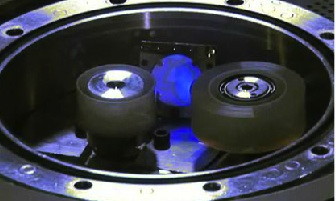
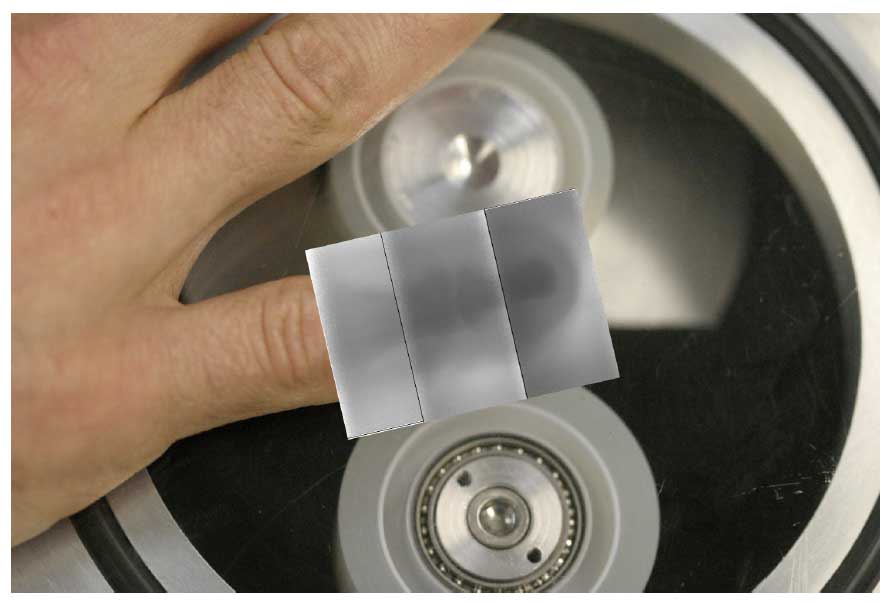
This project is an exploration of X-ray production from pulling scotch tape. You may not believe this, but hear me out. If you peel tape off a reel in a vacuum (~10^-3 torr) at a few cm per second rate, megahertz of 10-40 keV X-rays are produced, which are approximately dental X-ray quality! X-ray imaging is easy! Could this replace the expensive equipment used in medical radiographs? Possibly... but first we have to understand how it all works!
The original paper,"Correlation between nanosecond X-ray flashes and stick–slip friction in peeling tape," Carlos G. Camara1,2, Juan V. Escobar1,2, Jonathan R. Hird1 & Seth J. Putterman, Nature 455, 1089-1092 (23 October 2008) | doi:10.1038/nature07378; Received 30 December 2007; Accepted 27 August 2008, had an almost immediate reaction. The Nature video to accompany it contains a less detailed but informative introduction to the strange effect.
When two contacting surfaces rub together, they can produce visible light. This is called Triboluminescence, and, according to Camara et al., it is the process by which the X-rays are produced, with clear the implication that it is not, as previously thought, restricted to the visible light spectrum, but can extended several orders of magnitude beyond visible light. 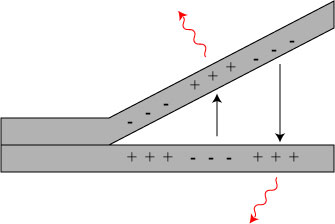
Add your name here to participate:
- Duncan Carlsmith
- Sam Carman